7.6.06

Antiphon and the Jewish Philosopher

A Jewish Philosopher says;

The non-existence of God, of course, defines atheism.

AR: Agreed (it’s actually the non existence of god(s) - atheism isn't just a rejection of the Judeo god, its also a denial of Thor, Zoroaster, and the Easter Bunny, but that may be just quibbling).

Atheists also do not believe in a soul; a soul implies spirituality and an afterlife, which atheists reject.

AR: Again, agreed, though spiritual dualism is not incompatible with atheism on its face (you can be an atheist and hold that the 'mind' is non-material in an empirical sense, ala Aristotle, and then there is the position of epiphenomenalism) , I will however concede that I personally believe the two are irreconcilable conceptually, largely because talk of the soul is ultimately incoherent.

The universe must be eternal since a created universe would require a supernatural creator.

AR: Not so. An atheist can quite reasonably believe that natural processes created the universe, and that it may have a finite beginning and ending completely independent of supernatural explanations. ‘Brane theory' is just such one example of a cosmological theory for the origin of the universe that is not god-dependent, and the fact of the accelerating expansion of the universe to what projects to an ultimate end of cold dissipation is neither inconvievable, nor dependent on any notion of a supreme being.

The universe must function completely automatically since anything else would be by definition supernatural.

AR: If by ‘completey automatically’ you mean 'by natural processes and without supernatural interference’, then you are again correct.

Although many atheists dislike being called “religious”, and think of atheism purely in negative terms as a rejection of God, atheism can be called a religion since it is a specific system of beliefs about God and spirituality. It is clearly a new, positive ideology in itself.

AR: Pure blather. Babies are born atheists. You have to teach them to believe in invisible things, like; Zeus, Santa, racism, etc. Atheism requires no specific adherence to a belief ‘system’ (Buddhists are after all, atheists, as are the secular officials of Communist China – yet they have mutually incompatible belief systems neither of which is derived from its atheism). Atheism is defined by the absence of belief, and hence it is the null or neutral position. Religions are collectives of people who share a common faith. Faith is belief in something in the absence of evidence, and religions are groups of people who share the same faith systems and objects.

Atheism, is precisely then NOT a faith, since there is no faith system or object that is common to atheists. We are defined by the absence of religion, and the reliance on other secular methods for exploring the world.


Naturalism, rationalism, materialism, empiricism, skepticism, secular humanism and scientism are virtually synonymous with atheism.

AR: Again, pure nonsense. Each of the above has a specific definition that, while related to some of the others on the list, does not necessarily entail any of them. For example, you can be a hardcore empiricist and not be a secular humanist, or atheist. The first is a process that is used to analyze the world (the empirical method), the second is a political stance based on a philosophy of humanism, the third is a simple philosophical position. As another example, you can be a materialist, and not be guilty of the supposed sins of 'scientism', a concept you'll note that itself has a variety of contradictory definitions.

For you to equate all of these with the broad category of 'atheism' and suggest they are 'virtually synonymous' is either mendacious or incompetent.

Agnosticism is basically a less confrontational name for atheism. It implies accepting the possibility of an impersonal God, although actually agnostics do not take religion in any way seriously and therefore are little different than atheists.

AR: To a point you are correct, agnostics are in fact a sub-set of atheists in that they do not profess any active faith. I suspect that most who label themselves as ‘Agnostics’ would prefer not to agree with the less popular slur of 'atheist'. This is the difference between ‘strong’ and ‘weak’ atheism. That is, the difference between having no position of belief ('weak atheism', or agnosticism), and that of believing all god-talk to be incoherent (strong atheism). Colour me a strong atheist.

The primary rational basis for atheism is the following arguments:

- The Argument from Evil. This argument states that if God exists, no small children would ever suffer since God would not permit that injustice. This was first proposed be Epicurus 300 BCE. [This argument is based on the assumption that man has no eternal soul. In fact, if man does possess a soul, then a suffering child may possess the reincarnated soul of a sinner who is justly deserving of punishment.]

AR: Actually the problem of evil is just the best reason to not believe in the Christian God of omni-benevolence, not necessarily the best reason to be an atheist. Take the following premises;

God is All Good (Omnibenevolent)

God created the universe

There is evil in the universe

Since God created the universe, God must have created evil

Therfore, god being ‘all good’ is logically contradictory and incoherent. That is the problem of evil.

- The Argument from Lack of Proof. This argument states that no religion has provided sufficient evidence to prove its claims. In fact, miracles are so unbelievable that it may be virtually impossible to produce sufficient proof to demonstrate that any miracle has ever actually occurred. This was first proposed by David Hume in “An Enquiry Concerning Human Understanding” published in 1758. [This argument is based on the assumption that God does not exist. In fact, if God does exist, miracles could easily take place. Just as he created the laws of nature, he can violate them. In fact, we would even expect God at some point in history to identify himself and communicate with mankind.]


AR: I’m unaware of any evidence that would satisfy claims of the miraculous, and given that the evidence of Santa Claus (the weather bureau faithfully announces his arrival on radar every year, the post office take his mail, etc.) is far greater than that of any miracle, I suggest it is reasonable to conclude that there is markedly less evidence for miracles then there is for Santa Claus. Admittedly, the evidence for Santa Claus is exceptionally poor quality evidence as well, but still of higher quality than for miracles. As to the contention that Hume’s argument is predicated on requiring more than the bible’s say so that something happened is necessarily true – you are again correct. He wants something more than mere ‘because the bible says so’, and so should we all.

- The Argument from Fossils. Fossil evidence allegedly proves that the first 34 verses of Genesis are fictional; therefore Judaism, Christianity and Islam are bogus; therefore monotheism and the concept of an afterlife are bogus. This was implied by George Louis Leclerc, Comte de Buffon in “The Epochs of Nature” published in 1778. [This argument is based on poor Biblical scholarship. In fact, the Jewish scholars taught 1500 years ago that earlier worlds existed before Adam. The fossils are apparently remnants of them.]

AR: Wow – and now we enter the realm of the weird. Ok, first and foremost, all of the sciences demonstrate that the early accounts of Genesis are fictional – not just the fossil record. Physics, Biology, Anthropology, Chemistry, etc. effectively all reject the biblical account of creation.

However, just because the sciences make Genesis into a metaphor rather than a true account of creation, doesn’t entail that monotheism and the afterlife are bogus.

They are indeed bogus, but not because the fossil record leads us ineluctably to think so. They are bogus because they are intellectually empty constructs.

The primary emotional attraction of atheism is the absence of all sexual restrictions.

AR: HA! I submit the primary emotional attraction of atheism is liberty from theocratic tyranny, the vibrant sex-life is simply a bonus side-effect of not having pre-medieval beliefs regarding the enjoyment of intercourse. Speaking of which, how's that whole hacking off a piece of your sex organ in the name of God working for you?

Atheists claim that their beliefs are different from other religions since they are completely rational and are simply based on pure logic and reason.

AR: I agree. Atheists are firmly part of the 'reality based community'.

Of course, members of many other religions claim that as well.

AR: And as an atheist I am willing to test the logic of my non-belief against their gobbledygook faith talk any day and any time. For every burning bush in your book, for every angel who is accosted by horny Sodomites, I've got a human footprint on the moon. Loaves and fishes? Science has cured Polio. Healing the blind? Please. I'll see your miraculous sight restoration in the bible and raise you with the sight restorations performed by science every single day at your local hospital. It's over. Every day reality has trumped your legend. You want to know why science and modernity have triumphed so resoundingly? It works.

Don't know what I mean? Try going a few months without that eminently modern and thoroughly non-religious invention toilet paper sometime. Just don't sit next to me.

Atheists must contend that although life on earth appears to have been designed, in fact it is merely the result of chance chemical interactions.

AR: Who says ‘life appears to be designed’? No scientist I’ve ever met.

Here’s a thought experiment if you think we are ‘designed’; Why do we have vestigial organs? What is god’s plan for the appendix anyway? In evolutionary language we can discuss the role it played in our past as a way of digesting plant materials – but we long ago lost that ability and the appendix now serves mostly as a means of collecting deadly infections. Or, how about our tonsils? Male nipples? The Coccyx? Wisdom teeth? Etc. etc.

Lastly, if we were designed, why did God use 99% of the design he used for chimpanzees and orangutans with only slight modifications?

Given enough time and space, anything can happen randomly. [The constructive portion of evolution is totally random; natural selection merely is the destructive part of the process which filters out all organisms unable to reproduce.]

AR: Natural Selection is defined here. Just in case you want to know what it means.

They must also assume that although Judaism is a remarkable religion, it is merely the product of some sort of mass brainwashing which occurred about 600 BCE in Palestine during the reign of King Josiah. The Jews at that time for some reason completely and fanatically accepted as true whatever their king told them, however obviously absurd it was.

AR: I can think that you are wrong in your beliefs without believing you are the victim of ‘mass brainwashing’. Though I am pleased to see you at some level are acknowledging the absurdity of them.

Evolution is not a proof of atheism but it is a crucial apology for atheism. It creates a false impression that atheists can explain the existence of life without an intelligent designer. [Many religious people believe in evolution because they have been deceived by atheists into believing that there is overwhelming scientific evidence supporting it. In reality, while there is proof that life on earth is millions of years old and has changed over time, spontaneous evolution from one universal common ancestor is nonsensical and unsupported by any evidence.]

AR: I have bad news for you, it's now a fact that we can explain the origin of man without resorting to any 'intelligent designer', and the evidence is indeed totally overwhelming.

What is nonsensical is your statement in brackets. Evolution is supported by ALL the evidence. There is no field of science that has thrown any doubt into the theory of evolution (indeed they all in their own way, confirmed it), and you simply can’t do modern biology without understanding how evolution impacts it. But let me take specific issue with your contention that ‘spontaneous evolution from one universal common ancestor is nonsensical’, or rather, let me ask you (since it isn’t clear) what exactly is ‘nonsensical’ about it? All life as we know it is based on DNA, which means the building blocks for everything from Mastodons to bananas to Jewish Philosophers is created by following a common alphabet of instructions in a common code. (Perhaps you don't believe in DNA? Or what it entails?)

So, given all that, what is nonsensical about suggesting that all life has at its core an ancient common ancestor in the primordial mulch of our early planet? In fact, it is exactly the kind of hypothesis that is open to falsification or confirmation by evidence, the essence of 'sensible'.

Humanism and utilitarianism are apologies for atheism. They create a false impression that atheists are obligated to follow a Christian-like code of morality. In reality, of course, if there is no eternal, universal lawgiver there can be no eternal, universal law.

AR: This may shock you, but people behaved ‘morally’ long before the Christian church was around. That is to say, moral codes of conduct are common to all civilizations, and peoples, even those societies that are explicitly atheist or secular. Humanism and utilitarianism are merely secular philosophies that have specific ethics. Interestingly, they both provide logical methodologies for arriving at their moral codes – and hence therein lies their appeal, since both (as well as libertarianism, conservatism, Marxism, etc.) seek to find a path to morality independent of the invocation of invisible super-beings.

Speaking of morality and Christianity, was it moral for God to ask Abraham to kill his son? Or for God to bet with Satan on the amount of suffering that Job could endure at the fallen angel's hands and still fear God more than Satan? Is polygamy immoral, and if so, why, since it's biblically prevalent? How about the stoning of adulterers? The biblical support for the keeping of slaves? Seems to me that if these are legitimate moral questions that the bible isn't always on the right side of, morality is distinct from Judaism and Christianity.

If Man is the highest moral authority then each man can fabricate his own rules, which are as legitimate as anyone else’s. An atheist is amoral.

AR: Atheism is not a commitment to total moral relativism. Buddhism is compatible with atheism, but it is by no means an ‘amoral’ philosophy. Likewise, libertarianism, liberalism and a host of other political philosophies satisfy the human need for rational ethical rules that promote a stable society and yet don't rely on supreme punishment or reward for enforcement.

If nature is indeed all there is, nature has no moral preferences.

AR: Atheism is perfectly compatible with saying there are moral preferences. It is perfectly reasonable to believe that ‘killing is wrong’ for secular ethical reasons. Further, there is every evidence that moral faculties are universal to human societies. How did the ancient Greeks arrive at a functioning democracy (albeit limited in scope) with respect for the rights of its citizenry without the benevolent guidance of Christian thinking? Obviously they did so in part because acting morally and abstaining from barbarism isn’t dependent on being a Christian.

An atheist can, and often will, honestly say “I am nice to people because doing so makes me feel good and helps me to be successful.” However he cannot say “I am nice to people because I am morally obligated to do so.” In practice, this is not often too relevant. Most people are ethical because of societal pressure or personal temperament, not fear of God. However on the other hand, active participation in modern Christianity or Judaism does seem to be generally therapeutic and aids many people in leading more peaceful, sober and productive lives.


AR: Says who? The divorce rate for all of us runs about the same. How is Judaism or Christianity ‘generally therapeutic’? Sounds like a placebo effect to me. Anyway, let me say this so we are clear;


“I am an atheist, and I am nice to people because I am morally obligated to do so. Also, I like people in general. Even those who practice bad philosophy'.

See? I just said it.

Higher Biblical Criticism, or the Documentary Hypothesis, is one atheistic interpretation of the Hebrew Bible. It assumes the existence of several "mini-Pentateuchs" during the First TempleSecond Temple era. This is a very unbelievable and complicated way to account for a few apparent redundancies and contradictions within the Pentateuch. After all, how did those earlier mini-Pentateuchs suddenly disappear without any trace? Were Jews the victims of national amnesia? I think the trend today is to assume that the Pentateuch was pretty much completely the product of an anonymous scribe in the court of King Josiah and he simply needed a better proofreader. era, which were then combined together into the full Pentateuch in the...


AR: If you say so, but given your record for creating atheistic strawmen to knock down, you’ll forgive me if I will remain doubtful of your conclusions.

Two groups of people seem to include the highest percentages of ideologically committed atheists: scientists and Communists.

AR: I’ll let atheists take credit for the former (science actually works), but not the latter.

Scientists frequently choose their profession because they are atheists to begin with. Atheists believe that nature is all there is and therefore atheists have a natural attraction to science which is the intensive and systematic study of nature. Just like most Talmudic scholars are theists, most scientists are atheists. Scientists have given a great deal of prestige to atheism however atheism is not scientific.

AR: Nothing much I disagree with in the above, except the final sentence. Atheism is compatible with science – perfectly so since science is the practice of methodogical naturalism, specifcally excluding supernatural explanations and searching only for natural ones. If every electricity experiment had to have included considering variables like, Thor's mood, or the proximate distance from Mt. Olympus, no science could ever have been done. Here's the thing, science works - that is produces repeatable and 'sensible' results, precisely because it ignores all the supernatural fluff you want to peddle and concentrates on what is materially testable.

There is in fact nothing atheistic about science itself. Modern science actually strongly supports religion in many ways. Biology demonstrates the complexity of life and therefore supports Intelligent Design Theory.

AR: Pure baloney. The first part, 'Biology demonstrates the complexity of life', is correct. However, there is no evidence anywhere in biology that supports ‘intelligent design’. None. Zip. Zero. Zilch. Not one paper in biology on the subject by a respected journal. Not one experiment proposed. Nor is there an understanding as to what something that is 'designed' in biology would look like - not even in theory. It is in the end a completely religious argument (not unlike ‘how many angels can dance on the head of a pin?’ the answer to which by the way is 'all of them'. Probably saved you a few years of study on that one. Your welcome).

Cosmology has discovered the Big Bang, which implies the existence of a supernatural creator.

AR: The Big Bang was deduced first by an astronomer and then later supported by physicists with evidence found in the natural world, not' discovered' by cosmologists. Further, the Big Bang does not necessarily imply a supernatural creator, any more than the opposite case for an eternal universe would necessarily imply one.

Indeed, it specifically does not imply the Christian god as supernatural creator (go back and re-read Genesis – then read any cosmology text on the big bang – you’ll be hard pressed to make the two fit in any meaningful sense).

A greater understanding of creation can lead to a greater love for the Creator. Great skepticism must be used when dealing with scientific proofs of evolution, since scientists are naturally inclined, if not to fabricate evidence, to slant the evidence toward their religious beliefs. [See “Icons of Evolution” by Jonathan Wells for some examples.]

AR: Sure, now I get it, it’s all a conspiracy of scientists.

Let me ask you something else, if you were diagnosed with cancer, would you go see an atheist oncologist, or depend on your local rabbi to pray you to health?

Communists believe that no organizations should be active in society other than the Party and therefore they support atheism.

AR: I’m not sure communists would put it that way, but I’m not interested in defending communism. They are not equitable to atheists. They have in fact, a comprehensive (and flawed) ideology that is secular (you may have heard of it before, its called ‘communism’), but even if all communists were atheists, that doesn’t mean that all atheists are communists. Nor is the presence of a political ideology like communism necessarily incompatible with religious belief, I use the liberation theology of Christian Marxists in South America as an example.

Outside of the scientific community and Communism, atheism is not too popular. Few countries have an atheist\agnostic majority and most have few atheists at all. Because atheists tend to have a low birth rate, it would seem likely that they will remain a small and perhaps shrinking minority.

AR: You wish. Church attendance in North America is still in steep and steady decline. The only churches for which this is not the case are the Southern evangelical churches of the US – who are explicitly cannibalizing other less activist churches for membership. Religion has been on a steady decline of influence throughout Europe as well. Eventually, the evangelical movement will run out of converts willing to tithe themselves to the apocalyptic cool-aid they preach, and a dampening of the general publics religiosity will continue.


Various levels of materialism and skepticism have always existed, especially in ancient Greece, however true, modern atheism is a fairly new religion, which originated in 1770 in Paris. James Thrower in “Western Atheism: a short history” p. 105 to 107 credits Baron D’Holbach as being “probably the first unequivocal professed atheist in the Western Tradition” with the publication of “The System of Nature”, anonymously in London, in 1770. Atheism began gaining wide popularity following the publication of “Origin of Species” in 1859. Atheism is the youngest of the world’s major religions.

AR: Atheism is not a religion. It is the absence of supernatural belief. Go back and re-read your own definition. You got it right the first time.

The rise of modern atheism seems to have been stimulated primarily by three factors:
- increased wealth in Europe, caused by greater trade, exploration and imperialism after about 1500, has meant less need for the comfort of religion
- the intensive study of fossils, beginning about 1780, has convinced many people that the Bible is bogus
- the publication of “Origin of Species” in 1859 convinced many that the teleological argument for God’s existence is incorrect.

AR: I attribute the rise of atheism to something else we philosophers call ‘The enlightenment’. You may have heard of it, though given your predilection for forcing the ‘Origin of Species’ into the picture as an atheist manifesto (it isn’t anything of the kind, but then, I doubt you’ve even read it) I am inclined to think you have chosen to remain ignorant of it.


The popularization of the Internet since about 1995, which includes many websites promoting atheism and promiscuity, would seemingly be a great step forward for the spread of atheism.

AR: Atheism will spread because all faith systems are rotten to their intellectual cores. They contain no ‘truths’ that can be verified, make no evidentiary claims that can possibly be pursued and insist on a host of incoherent claims (bushes that talk while burning, angels, demons, hell, heaven, people rising from the dead, father figures waiting for us in a paradisical afterlife, lakes of fire, etc.)


Sure Atheists get to be more clear-headed about sexuality than Christians do (Onan anyone?), but that isn’t equitable with ‘promiscuity’.

Japan and Scandinavia are cited as successful societies with very high proportions of atheism, however North Korea and Vietnam could be cited as counter examples.

AR: The atheism of Asian countries has a different origin than the atheism of Scandinavian countries. Scandinavian countries are properly thought of as being ‘post-Christian’. Denmark still has Christianity as its official state religion, but in practice the society has evolved to being fiercely secular. In contrast, Japan’s history shows us they have long experience with ‘atheist’ belief systems that are not related to Christianity at all. Buddhism, Confucianism, etc. all influence the Asian countries in ways that are not comparable to the post-Christian secularism of Scandinavia. Further, consider the post-communist atheism of the Czech Republic (where a majority of citizens declare themselves to be atheists, but no longer have any truck with ideological communism), the enforced secularism of Turkey, or the secular multi-culturalism of my own country, Canada. There is no parallel to be drawn between these nations other than their insistence that someone's delusion of an invisible overlord isn’t the best way to determine the supreme law of the land.

Atheism would seem to have a significant negative impact on its adherents and on society when one considers that active participants in modern day Christianity and Judaism exhibit lower levels of criminal behavior, substance abuse, depression and suicide than their secular neighbors. (Orthodox Jews may have the best statistics.)

AR: Now you are just making shit up.

On the positive side, many great advances in modern technology and medicine have been created by atheists. But since modern technology includes many extremely effective weapons systems, some of which threaten the existence of life on earth, its real net value may be questioned.

AR: Question the net value of science the next time you need a root canal. Seriously. Go ahead, you can bitch about the weapons systems but only if you don't go to the dentist.

You can use science to create anaesthetics or nerve gas. Science tells you how to forge iron, and you can hold science responsible for the swords so long as you are giving science all the credit for the plowshares. Do you have clean potable water treated by chemicals to remove parasites where you are? Just wondering.


Since atheists tend to be solitary they do not have many children. This is one of the main reasons for the low birthrate among Caucasians, who seem to be heading gradually toward extinction. For example, Bangladesh has a larger population than Russia.

AR: The fastest growing population of atheists is in India. The largest officially secular country in the world is China. Atheism is not a cultural or religious phenomenon because atheism is common to all cultures as a rebellion against its dogma.

One may generalize that the more atheistic a society is, the more technologically advanced it will tend to be, however also the more unhappy and infertile. The wisest strategy may be to enjoy the social and emotional benefits of religion while at the same time enjoying the technology created by atheists. Many people do just that.

AR: You have hit the nail on the head here, science is good for many things; creating comfort, active economies, creating wealth, curing disease, creating weapons to protect ourselves from our enemies, creating actual knowledge etc. Whereas, religion is good for…making you feel better. Just like Santa Clause does for kiddies. Or what Marx said about the masses and their favourite opiate.

When atheists have full political power, as they did for example in the Soviet Union, they tend to be extremely intolerant of other religions, just as adherents of most religions are when they have total control of the government.

AR: Human nature at its best. 'Power corrupts and absolute power corrupts absolutely'. Atheists aren’t immune from any moral disease of humanity. That said, Europe, Canada, Australia, represent actively secular tolerant societies, so it's not like secular countries are exactly hellscapes. Compare them to some Abrahamic religious countries you should be so proud of, like say, Iran, or Pakistan where everything is perfectly fine thanks to the imposition of divine law. Or perhaps you prefer that period before the Enlightenment? You know, when the church was the supreme authority, and all knowldge flowed from it? You know, the 'Dark Ages'.

Atheism has its own revered visionary founder, Charles Darwin, and sacred scripture, “Origin of Species” [like the Bible, few read it]. It has its own code of behavior which comes in two flavors – Communism and humanism. There has been an effort to create atheistic congregations, in the Society for Ethical Culture, however most atheists are too self-centered to be part of any society.

AR: Darwin is hardly a beacon of philosophical atheism. He is however, one of the most important thinkers ever, not for any contribution to atheism (which is frankly meager at best), but for his contributions to science (impossible to calculate).

Atheist heroes tend to be; Socrates, Voltaire, Camus, Kierkegaard (an atheist Christian), Nietzsche, Hawking, Dawkins, Sagan, Asimov, Clarke, Dennett, Huxley, Russell, Hume, Flew, Mencken, Mill, the CFI, etc. etc. Darwin is on that list, in part because he provided an expanation that he knew would not be popular with the church on human origins, but his writings on atheism is extremely thin. He is a hero for atheists because of his intellectual honesty in the face of seemingly intractable theocratic unfavour, but not for any teleological coup d'etat.

As evidence, Darwin wrote vastly more about the reproduction habits of snails than he ever did about god or atheism. 'Origin of Species' is not a philosophical text.


Atheism is of great interest to Orthodox Jews because in recent decades, if an Orthodox Jew chooses to convert to another religion, that religion almost invariably is atheism. This is not surprising when one considers that among Caucasians world wide, atheism is rapidly growing today.

AR: in other words, when an Orthodox Jew comes to his intellectual senses and abandons his faith, he tends not to make the same mistake again by jumping to another faith. I call that progress.

In my opinion, atheism is clearly a false religion since, aside from being based on weak arguments, it cannot plausibly account for the existence of the universe, the existence of life or the history of the Jewish people.

AR: Hunh? Since when does atheism have to account for any of that stuff? If you want to discuss what you think is so ‘weak’ about the arguments for atheism I’m all for it. But atheism doesn’t have to spend any energy explaining the life of the Jewish people, the origins of life on earth, or the origin of the universe. The first is a sociological and historical question, the last two are scientific. Atheism is compatible with both history and science, but it is not identical with them.

As with members of any other religion, it is almost impossible to debate with committed atheists. Especially if you are young and single, atheism is fun. Atheism means living a life with fewer rules and atheists will grasp at any excuse to hang on to that. “God made me? No, evolution made me.” “The Torah was given at Sinai? No, King Josiah wrote it.” “Orthodox Jews are morally superior to atheists? No, they are just better at covering up their crimes.” It’s impossible to get beyond the wall of total denial.

AR: As an atheist I can tell you I have no opinion one way or another on the Torah, Mt. Sinai, or King Josiah, nor do I feel the need to commit to one, anymore than I feel the need to declare a favourite among Santa’s reindeer (ok, you got me, it’s Blitzer, truth be told. Once we added the bbq sauce, he was perfect). As for the notion that I hang on to my atheism because ‘there are fewer rules’, there are indeed fewer rules. I’m not bound by dietary restrictions that are nonsensical (as the ‘Pulp Fiction’ reference goes; ‘Pork tastes good, bacon tastes good.’), nor do I feel bound by half of the ten commandments (1-4 and 10 can all go as far as I’m concerned), and the parsimony of my belief system is indeed a strength for me. So I guess I'll agree. Atheism is less complicated than invisible super beings.

Ultimately, it’s a very strange philosophy – believing that all men are merely soulless robots, created spontaneously from simple chemicals (through a gradual process which took a few billion years), functioning automatically until they stop and disintegrate. There is no such thing as choice or personal decision.

AR: I am not a Cartesian dualist (I don’t believe in the soul), but then, spiritual dualism is an incoherent proposition, and one I would happily debate with you. We are not however, mere ‘robots’ as you say. Daniel Dennet (a high functioning atheist if there ever was one) has written extensively about how free will is compatible with atheism and evolution (see his work: ‘Freedom evolves’), so to suggest we atheists are deniers of free will is simply wrong. But let me turn the tables on you with regards to the question of free will.

If God is; omnipotent, and all-knowing (omni-prescient) then, it logically follows that any decision we make, He knew we would make it in advance. All choices we make are therefore predestined by God, and no human free will is possible (we are all simply following God’s plan). Even those who choose atheism are predestined to do so, and God has condemned us knowingly to hell before we were ever born (which also brings us back to the problem of evil). There is nothing conceptually compatible between a supreme being with omnipotence and human free will.

Atheism, on the other hand is predicated on there being no supernatural beings. Hence, we are not predestined to do anything, and are free to make decisions. I submit then that atheism is philosophically compatible with free-will, while theism, is not.

Our “free choice” is merely an illusion. No one is good or evil since all behavior is automatic, not chosen. If someone shoots a hundred children he is no more evil than a tornado or a tsunami; his brain chemistry and environment caused him to do it. Can anyone really believe that without, as Nietzsche did, losing his mind?

AR: You have now openly confused atheism with moral relativism. Not that surprising given the way you have mistakenly characterized atheism throughout your piece. Lastly, Nietzsche lost his mind because he had syphilis, a known material cause for his deteriorating mental state. If you believe in spiritual dualism, then how do you account for the interaction between the physical world (his syphilis) and his ‘mind’? How does the virus affect the spirit world anyway?

I look forward to any response you care to make.

Antiphon

6.6.06

The Storms of Jupiter

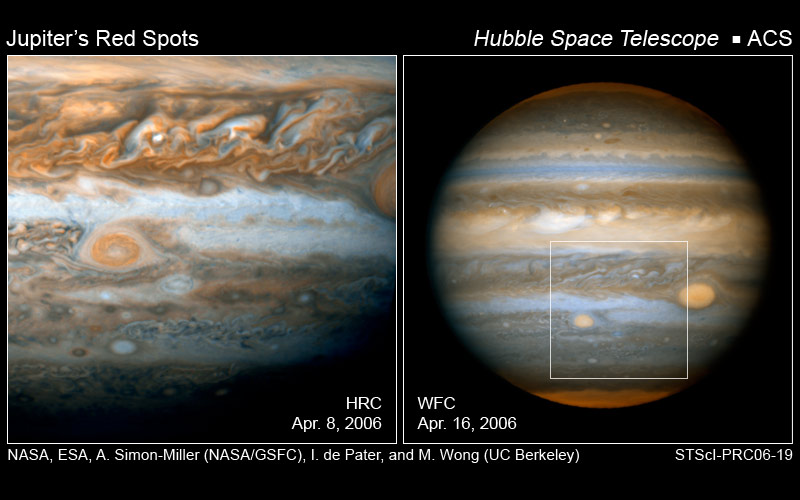
Jupiter has developed a second super-storm (the 'small spot') that bears the same brick red colour as the more familiar 'Great Red Spot'.

The colour red is important in that it likely indicates that the storm is powerful enough to dredge material from deep in Jupiters atmosphere and bring it to the surface where it provides colour to the storm.

The spots are destined to come very close to each other, but so far speculation is that they will not merge.

31.5.06

On the Oilers and Indifference

So the Oilers in the Stanley Cup Finals, eh?

I know this will get me some grief from Canadian hockey fans, but I honestly, don't care.

Don't get me wrong, I'm not cheering for Carolina or Buffalo to beat the Oilers, not at all. I could never root for an American team to beat a Canadian squad.

You see, I don't care anymore because if my only options are to root for the Oilers or to root for an American team, well, I'll watch Steve Nash play instead thanks.

Why? I'm from Calgary. If that doesn't explain it, maybe this will.

The shift to shift war of Otto vs. Messier
Glenn Anderson being Glenn Anderson. Which is to say, scoring a lot of pretty goals and being a complete dick about it every single time.
Esa Freaking Tikkanen.

and of course;

Glenn Sather and Peter Pocklington. A Bush/Cheney duo before that horrific notion was ever spawned.

Let me also be clear, this has nothing to do with Gretzky. Everybody likes Wayne, even shell-shocked Calgary fans from the battle of Alberta grudgingly respected him for being a god-being. We could root against him while also respecting his never before seen talent.

But cheer for the Oilers? Never. They have 5 cups. Calgary has one. When Calgary has six, maybe THEN I'll give the Oil some love. But not before.

Till then, I'm paying attention to one of the greatest sporting events in Canadian sport history - our two time NBA MVP and his off-this-world performance leading the Phoenix Suns.

If it's a choice between giving my boosterism to Ryan Smyth or Steve Nash, it's really no choice at all.

Go Suns!

30.5.06

Howling at the Moon


Given the recent additions to the number of moons for Pluto and other planets, here is a quick recap on which planet has how many moons!

Mercury - 0
Venus - 0
Earth - 1
Mars - 2
Jupiter - 63
Saturn - 49
Uranus - 27
Neptune - 13
Pluto - 3
Sedna (Xena) - 0


Magneto the 'ecoterrorist'?


The NRO hacks review X-Men III with predictably hilarious results! I guess I shouldn't expect better from these guys, but some of this review is just really
bad;

"As in the first two films, much of the movie is concerned with not just the fight for mutant rights, but the fight over just how to attain those rights. In the movie’s universe, mutants are the all-purpose minority interest group. The X-Men are the patient, generally peaceable crowd that wants to work from within the system and live pleasantly and equally alongside their human counterparts. Professor X runs a boarding school that offers courses on superpower ethics, while Beast heads up the government’s department of Mutant Affairs. Their idea is to lobby for their interests; think of it as the mutant K-Street project."

Mutant rights is like the K Street Project? Uh,...no. The lobbying for mutant rights is directly analgous to, oh, I don't know, the ACLU maybe? Whereas the 'K Street project' was the brainchild of GOP reptile extraordinare Tom Delay, and revolves around replacing the nominally bi-partisan lobbyists of Washington with Republican friendlies, ensuring a smooth relationship between donations, graft, etc. between the corrupt Delay congress and the corporate lobby groups. How that project dovetails with 'mutant rights' is beyond me, but its clear the attempt is to project the meme that the K-Street project is 'just the lobbying of congress'. No corruption here. Move along. But wait, this fever dream of a movie review gets even better;

"Magneto and his crew of tattooed, leather-clad nasties, though, are the mutant equivalent of ecoterrorists. They want to take human society by force and subjugate it to their whims. Where the Spider-Man movies were all about the superhero as individual, the X-Men films are all about superheroes as a group. But Ratner’s film can never bring itself to say anything more complicated than evil mutants are bad news. The film sets up a potentially interesting clash between activism and militancy, but fumbles when it comes to resolution."

In Peter Suderman's world, when an aggrieved minority seeks to subjugate humanity to it's whims, the first example he thinks of is 'ecoterrorists'. Get it? Magneto = tree huggers. The mind reels.

Here's a counter-reading for Mr. Suderman. The evil mutants under Magneto's influence want to subjugate humanity. Why?

Revenge for past wrongs and their own future security, coupled with a sense of superiority at being 'different' from everyone else. They are culture warriors who find themselves surrounded by a hostile, corrupt and violent culture, and are forced to interact with mediocre humanity and its barely restrained intolerance towards their superiority. Magneto's claim that the mutants are 'homo superior' and thus the natural inheritors of humanities leadership is nothing less than a restatement of Platonic political ideology. Those fit to rule, should (and how do you argue with Magneto that he isn't fit to rule?). Xavier's group wants to help educate humanity about the humanity of mutants. Mangeto's group wants to take control of humanity and force it to accept them - or else. Xavier's group is (as mentioned) clearly analgous to the ACLU.

Magneto's group however, aren't they clearly less like 'ecoterrorists' and a lot more like the neo/theo-cons of NRO?

Picture of the Day

The Omega Centauri Globular Cluster

26.5.06

Pulp Pictures

'Slate' magazine has a feature where artists create 'Pulp novel' covers for lit classics. Click the link in the header to be directed to the article.

Towel Day!

To celebrate the late, great Douglas Adams!

Why Towel Day?


To quote from The Hitchhiker's Guide to the Galaxy.

A towel, it says, is about the most massively useful thing an interstellar hitch hiker can have. Partly it has great practical
value - you can wrap it around you for warmth as you bound across the cold moons of Jaglan Beta; you can lie on it on the brilliant marble-sanded beaches of Santraginus V, inhaling the heady sea vapours; you can sleep under it beneath the stars which shine so redly on the desert world of Kakrafoon; use it to sail a mini raft down the slow heavy river Moth; wet it for use in hand-to-hand-combat; wrap it round your head to ward off noxious fumes or to avoid the gaze of the Ravenous Bugblatter Beast of Traal (a mindboggingly stupid animal, it assumes that if you can't see it, it can't see you - daft as a bush, but very ravenous); you can wave your towel in emergencies as a distress signal, and of course dry yourself off with it if it still seems to be clean enough.

More importantly, a towel has immense psychological value. For some reason, if a strag (strag: non-hitch hiker) discovers that a hitch hiker has his towel with him, he will automatically assume that he is also in possession of a toothbrush, face flannel, soap, tin of biscuits, flask, compass, map, ball of string, gnat spray, wet weather gear, space suit etc., etc. Furthermore, the strag will then happily lend the hitch hiker any of these or a dozen other items that the hitch hiker might accidentally have "lost". What the strag will think is that any man who can hitch the length and breadth of the galaxy, rough it, slum it, struggle against terrible odds, win through, and still knows where his towel is is clearly a man to be reckoned with.

23.5.06

Long Weekend Roundup

Ok, so I haven't posted much of late, but the wife was back in town for the long weekend, a friend needed some help getting moved, a poolie in the FUNHL is having cold feet about sticking around, and my invasion of the Japanese was in full bloom (Civ3:conquests) so I just didn't get it done - mea culpa.

Here then, is a backlog of stuff that I have been meaning to post as individual items, but to clean out my files, I am presenting them all here to you now, in one giant post. Feel the love!

How many planets are there in the solar system?
You'd figure that a grade schooler would be able to answer this question, right? Wrong. Astronomers are discovering that there are planetary sized bodies (i.e. bigger than Pluto) further out in the Kuiper belt. Do we count these as planets? Or do we create another classification for them? How far away do we make the cut-off?

How did life evolve?
Natural History Magazine takes a look at the current science on the origins of life. Contrast that marvelous essay with this video clip by Kent Hovind, defending the biblical time-line on origins of life. If you can sit through the entire thing without hurling either insults or something more tangibly heavy at the screen you are a better man than I.

Remember the 'Hobbit'?
Anthropologists are struggling to classify the ancient bones of a female with a remarkably distinct skull formation discovered on the remote island of Flores. Is it a potentially explosive example of Homo Erectus - one that inexplicably uses tools and other technology? Or is it simply the skeleton of a poor human woman who suffered from microencephaly?


Is belief in God(s) an evolutionary adaptation?
Daniel Dennett thinks so, and so do these guys. I suspect that they are correct, but not in the religion specific manner the way the question itself begs. I am betting that we are all wired to make inferences - some good, some bad, but more good than bad (because if they were more bad than good, we wouldn't survive so well as we would if we selected for good inferences) and the god question therefore arises from making an inference about causation where the cause inferred is some 'ineffable intelligent agent'. In other words, the way our brains are wired to succeed in the world (making more good inferences about causation) unfortunately leads us to make inferences about the supernatural that can't be proved or disproved - and so they linger.

The war against the Infidel:
It seems Americans trust atheists the least. But given that a reported 71% of Americans believe in the existence of the Devil, with a full third believing in UFOs, Astrology, and that old standby, ghosts, perhaps the problem doesn't lie with the PR representation of atheists. Me thinks instead that the real problem lies with Americans.

Interestingly enough, one potential answer to the problem of intolerance in relgion isn't to resort to my preferred secular atheism, but rather to promote what I call the 'Battlestar Galactica' solution.

Can Michael Ignatieff be rehabilitated?

IMO Yes, and he will be the next leader of the Liberal Party of Canada - and subsequently, he will eventually be PM. Sorry, but Ken Dryden doesn't have enough, and everyone else is too small fry.

Shadia Drury throws down the gloves and attacks the notion of activist Judges.

One of my former profs, and easily one of my favourites. I could never have tackled the convoluted moronism of Michel Foucault without her.

The Future of Books. The Future of Movies.

On Gay Marriage and Polygamy: One of the classic rebuttals by those who don't wish to legalize Gay Marriage, is that it will lead us down the slippery slope to Sodom and Gomorrha. Usually, the argument goes like this;

"If we allow two men to marry, or two women, why not two men and a woman, or two women and a man? Why not marry your dog?"

It's a blast of horror at the notion that once a standard is revised or changed, or even examined closely, it will be undermined until all that is sensible and sacred is tarnished. Of course, it's pure bunk. There are however some serious concerns with polygamy, but they are distinct from the Gay Marriage debate entirely. As a theoretical notion, polygamy has an appeal for legal recognition, but I will argue from a practical standpoint, it is doomed.

First, here's how the two are different. Gay Marriage is still between two people, what has changed is that the barriers placed on the sex of the participants has been removed. Is this a moral relativisim that irrevocably leads us to legalizing polygamy, does changing the sex part of the marriage equation make the number of members also open to change?

By changing the laws to allow gay marriage, no existing marriage is changed, but the definition has been broadened to include those it previously didn't. My relationship with my wife is not impacted one iota by allowing others previously excluded from marriage to participate - indeed, I would argue that if the institution of marriage didn't recognize gays, a legal marriage simpy isn't worth the paperwork, and I'd have been happy to live in sin rather than support the open bigotry of marriage under those conditions.

However, allowing polygamy to be legal would definitely change my marriage. Whereas before there was no question that it was just the two of us moving forward, now the contract I agreed to has had one of its underpinings removed - the exclusivity of our relationship, and that has consequences for both of us.

That's more of a legal technicality as objections go, but there are serious policy consequences of allowing Polygamy. In theory, allowing Polygamy would create as many multi-male relationships as it would multi-female, but the facts say different. From an historical standpoint, marriage was less a romantic development than a property exchange - the security of the man's income and labour for the reproductive right of access to the woman. (Sure it's sexist, but this is the history of sex we are talking about, and I didn't design the plumbing). But we can already see how polygamy plays out in the real world - a tendency of rich men to collect as many females of breeding age as possible - with the extraneous males punted out of the commune, and the flip side, where two men marry a woman, is all but non-existant. This leads inevitably to a socio-political nightmare - few men marrying many wives leaving many without any.

My main objection though is how Polygamists 'recruit' new brides, usually by coerced marriage of a sister or relative of a current wife, often taking place well before any reasonable notion of adulthood has been reached by the potential bride.

My conclusion on the subject is this; Polyamory is fine (so long as it is above board), but legal recognition for the third or fourth party isn't, not because it violates the spirit of marriage (it clearly doesn't - lots of biblical polygamy as evidence), but because it violates the social fabric of existing marriages, and because in practice it leads to both coercion and in the harshest light, pedophilia.

In any case, there are some excellent writings on the subject, here, and some much less excellent writing here.

We Can Build You: Two very interesting developments in gene-tech.

First; what kind of pet do you want?

Second; what kind of baby do you want?

Funny enough, but the first question is probably a lot more explosive than the second. Designing the genes for a new kind of pet, is still speculative, but I suspect there would be much more opposition to my owning a genetically designed dragon, than having kids born without the genes that cause systematic blindness. Which sort of typifies how the debate on genetic modification goes. On the one hand you have people making all sorts of sci-fi claims, like the designer pets story, but on the other hand you have the practical application of science in rooting out genetic demons that plague us.

I'll paraphrase a friend of mine when I say this, but, we humans are some damn clever monkeys.

10 Things I hate about Commandments:

Check out the video, here. Hilarious!


Two Sports Questions:

Is Doug Flutie worthy of the Football Hall of Fame?

How many career home runs would Barry Bonds have if he hadn't started injecting the juice around 1998?

Debate Club News!:

No, I'm not going to talk about Liberty College and how their debate team has had it's win stats improperly construed to make them 'the top debate team in the US' - others have crapped on that analysis enough. No, the news is more disturbing than the unrelentingly polyanna PR a Christian university is getting for their debate team. It's called the 'Louisville Project' and it's about as disturbing a trend as I've ever heard of in the world of speech and debate.

As with all the walkways to hell, this one is also being paved with good intentions.


Star Trek vs. Religion and Kirk vs Picard!

In both cases, it's obvious who wins (ST and Kirk), but here are some of my favourite reasons (there were more than 1900 last I checked) given for preferring the balls-out cowboy Kirk to the mincing diplomat Picard;

1872. Kirk's first order as captain of the Enterprise: "Take her out of the Galaxy, Mister Mitchell." Picard's first order as captain of the Enterprise: "We surrender."

1821. When Kirk finds a mother alien defending her young, he saves her even at great risk to himself ("The Devil in the Dark"). When Picard meets the same, he kills her ("Galaxy's Child").

329. Picard has his girlfriend transferred. Kirk had to watch his girlfriend die in order to save the future.

133. Two Words: Comfortable Velour.

41. Kirk plays god with lesser cultures, then exploits them for resources.

9. Kirk had Yeoman Janice Rand.

2. Kirk beat up Soran. Soran *easily* beat up Picard. Therefore, this proves that Kirk could easily beat up Picard.

Speaking of loving a good fight:

Hitchens vs Cole

15.5.06

For All Mankind


The 'Criterion Contraption' has his latest review up!

9.5.06

Neanderthals - the Debate

Neanderthals and humans, perhaps they never met?

This is the kind of interesting scientific debate that goes on under the surface of pop culture because it lacks any obvious political spin value (though these guys will no doubt have an entertaining perspective if they get around to it).

To me there is nothing preposterous about either position, and I look forward to the evidence vindicating one side or the either (or neither).

That said, if Neaderthals and humans were contemporaneous, then there is absolutely no doubt in my mind that some interbreeding took place.

Why? Simply put, because Larry Flynt lost his virginity to a chicken (which, when you think about it, explains perhaps too much).

And given that the outer limits of human sexuality must include barn fowl, it seems to me a total certainty that a 'Quest-for-Fire' human male with his primitive standards for things like hygiene, and the hirsuteness of his women, would find even the lowliest of horny neanderthal trollop a more attractive option than Flynt found his chicken.

A few drinks, the exchange of small talk grunts, a large club (probably the femur from a large herbivore), and the next thing you know, interbreeding.

And am I the only one who finds it appealing to think that something of the neanderthal lives on in us? Something old and heavy stuck in the grains of our fabric, never quite cleaned out of the wash?


5.5.06

Picture of the Day

The hand prints are the winning touch.

Is American Foreign Policy an Infinite Crisis?


From 'Reason' Magazine

This article has it all! Politics, comic books, and comic books as politics!

Gregg Easterbrook is an IDiot

A few years back Easterbrook was by far my favourite writer about the NFL. He was funny, erudite, knowledgeable, and his opinions on everything reeked of fanboy delurium. Then he went and said some really stupid things about Jewish control of Hollywood, and it cost him his gig.

Well, he's back writing for ESPN. Unfortunately, he hasn't smartened up all that much in the interim. Like the once admirable author Orson Scott Card, Easterbrook fell for the odious 'Intelligent Design' theory hook line and sinker, going so far as to write really stupid things in its defense.

Now, on the whole its much better that Easterbrook be out and proud of his intellectual backwardness when it comes to ID theory than cagey and specious about his anti-semitism, if only because its a lot easier to chart his lunacy when he isn't trying to mask it.

Here's his latest stupidity;

"Here's the rub, unmentioned in news coverage of the Mars water finding: Readings suggest liquid water last flowed on Mars 3.5 billion years ago, and has not done so since. How could this have happened? An essential aspect of Earth's geologic history is the "faint sun" problem. When the Earth formed, about 4.5 billion years ago, our star, Sol, gave off less heat and light than today. It is thought that for much of the early eons, Earth was a snowball, because the sun's heat was insufficient to melt water on our world. Gradually solar output increased as the material of our star compressed; somewhere around a billion years ago, Sol began emitting as much heat as it does today, the Earth warmed, and complex life followed. But if Earth was a snowball 3.5 billion years ago how could Mars, much farther away from the sun, have been warm enough for flowing water?"

Ok, where to start?

A. It is not an 'essential problem' of solving the Earth's geologic history that we uncover the 'faint sun' problem, since most rational people have concluded that natural processes like the 'greenhouse effect' (see: Venus) can account for the warm temperatures found on earlier Earth.

B. It is not thought that much of Earth's early history was that of a snowball, in fact, it is understood that the Earth was relatively close its current temperature for most of its history (with variations in temp that acccount for the occasional ice-ages etc.). What needs explanation is not how life developed on a snowball, but why was Earth not a snowball if the Sun's output is only 75% of what it is now.

C. Ditto for Mars. Mars gives us all the evidence of having been both warmer and wetter in its past than it is now. Again, atmospheric composition is the most likely candidate for explaining this phenomenae.

Ok, so why is Easterbrook so interested in this 'essential problem if earth's geologic history' that is neither essential nor a problem?
I think it's because he spends too much time reading these guys, and taking them way, way too seriously.

They are all Meat

Here is proof that good science fiction movies can be;

1. Short
2. Funny
3. Light on special effects
4. reliant on no-name actors like 'Mr Dollarhyde' from 'Manhunter' to great effect.

4.5.06

Colbert vs the Media lapdogs of BushCo.

Header-link takes you to the video of Colbert's speech at the WhiteHouse Correspondents dinner.

It will no doubt be considered a classic comedy piece over the coming decades for several reasons;

1. It is painfully, screamingly, funny.

2. The audience made up largely of politicos, military and media are the targets of Colbert's acid satire, and for the most part, they either; don't get the joke, get the jokes but don't think they are funny, or worst of all, realize that they are in fact the joke, and Colbert is simply telling them the truth. In any case, the laughter from the audience is sparse, and at best intermittent, causing some pundits to claim he 'bombed'. Far from it. It's the sound of an entire news culture having its nose rubbed in to the reality of their craven cowardice.

3.5.06

Australian Rules Football and Michel Foucault

It seems the monster of post-modernity is still alive and well and kicking footballs in Australia.

What does the intellectually deranged relativism and post-Nietzche malaise of Foucault have to do with sports backwater chimera child of soccer hooliganism, rugby and head injuries, you might ask?

It seems Foucault's identity politics (how power shapes identity - in this case, how media portrayals and charcterizations reverse form a players personality) are being used to address 'character issues' in recruiting players.

In other words, frankly speaking, not a damn thing at all.

That all said this is the capper;

"
Then, player salaries were lower and footy clubs were almost carefree in their risk-management practices. Nowadays, the write-off cost of a defective or disruptive footy player is bigger, and thus so are the worries of prudent footy executives. Foucault helps them to tackle those worries.

Elsewhere, the business community has been, on the whole, slow to adopt Foucault's contributions to the philosophy of accounting. But the Australian Football League has built itself a platypus of a game by incorporating odd elements from the most unexpected places. It is unafraid to throw something different - even a dead French intellectual icon - into its business plans."


So at least the owners seem 'reassured' by these Foucaultian influences, which perhaps is the best PM joke of all.

Picture of the Day

2.5.06

Quote of the Day

`You don't believe in me,'' observed the Ghost.

``I don't,'' said Scrooge.

``What evidence would you have of my reality beyond that of your senses?''

``I don't know,'' said Scrooge.

``Why do you doubt your senses?''

``Because,'' said Scrooge, ``a little thing affects them. A slight disorder of the stomach makes them cheats. You may be an undigested bit of beef, a blot of mustard, a crumb of cheese, a fragment of an underdone potato. There's more of gravy than of grave about you, whatever you are!'' - Dickens

Fermi's Paradox

In a previous post I mentioned that my favourite math of all time is the 'Drake equation' that calculates the number of potential intelligent species sending out radio signals per galaxy. In that post I mentioned that when I ran the numbers I would get an answer in the hundreds or thousands, and this prompted a minor debate between Richard and I over the variables.

Mea Culpa. I am saddened to point out that when I run them with a clear head, even my optimistic calculations still yield just one or two for our galaxy, and not the teeming multitude that I had thought.

Related to the Drake equation is the Fermi Paradox, which was a speculation on the presence of intelligent life in the galaxy that preceded Drake's calculation by two decades.

I've culled the following definition from an article whose response to the paradox is not only 'radical' but I think typically anthropocentric in it's limited vision.

Sometime in the 1940s, Enrico Fermi was talking about the possibility of extra-terrestrial intelligence with some other physicists. They were impressed that life had evolved quickly and progressively on Earth. They figured our galaxy holds about 100 billion stars, and that an intelligent, exponentially-reproducing species could colonize the galaxy in just a few million years. They reasoned that extra-terrestrial intelligence should be common by now. Fermi listened patiently, then asked, simply, "So, where is everybody?" That is, if extra-terrestrial intelligence is common, why haven't we met any bright aliens yet? This conundrum became known as Fermi's Paradox.

AR: I think Drake's equation coupled with modern astronomical theory solves the paradox for Fermi;

A. The premise is incorrectly understood, I suspect a function of 1920's astronomy. Intelligent life in a the universe is extremely likely given the staggeringly large number of stars that would be ideal for life to generate. However, Drake's equation shows that at any given time a galaxy of roughly our size would have only 1-5 intelligent species capable of radio transimission. So while the universe itself could be teeming with life, our own neighbourhood - the milky way, could well be barren save for us, and even if we lucked out and the number is higher, there is another problem;

B. Even if the galaxy is teeming with life, it is still a very, very, very long way away, and light speed is still the speed limit for getting any place. If you want to calculate how many alien species develop technologies that violate the light speed barrier so that they can buzz Kansas farmers at will, be my guest, but the odds on favourite way for us to discover intelligent life in the galaxy is with a radio antenna, not UFO hunters.

So there is my bashing of Fermi's paradox, but the real fun is what follows;

"I suggest a different, even darker solution to the Paradox. Basically, I think the aliens don't blow themselves up; they just get addicted to computer games. They forget to send radio signals or colonize space because they're too busy with runaway consumerism and virtual-reality narcissism. They don't need Sentinels to enslave them in a Matrix; they do it to themselves, just as we are doing today. Once they turn inwards to chase their shiny pennies of pleasure, they lose the cosmic plot. They become like a self-stimulating rat, pressing a bar to deliver electricity to its brain's ventral tegmental area, which stimulates its nucleus accumbens to release dopamine, which feels…ever so good."

You see, Mr. Miller is an assistant professor at the university of New Mexico in Psychology, so naturally the premise for why we don't see more intelligent species in the galaxy visiting us is a psychological one, that the aliens fail to build radio antennas because they become decadent, selfish creatures addicted to pleasure.

Here is Miller again;

"I suspect that a certain period of fitness-faking narcissism is inevitable after any intelligent life evolves. This is the Great Temptation for any technological species—to shape their subjective reality to provide the cues of survival and reproductive success without the substance. Most bright alien species probably go extinct gradually, allocating more time and resources to their pleasures, and less to their children. They eventually die out when the game behind all games—the Game of Life—says "Game Over; you are out of lives and you forgot to reproduce."

AR: So the suggestion is 'they forget to reproduce'. Cuz, you know, we see that all the time. Creatures everywhere reach a stable population, and then, you know, forget to reproduce. Honey I don't feel like sex, because I have an iPod!

I'd say Miller's insight falls somewhere short of genius. But we do get further insight to both his technophobia and his erotophobia here;

"Heritable variation in personality might allow some lineages to resist the Great Temptation and last longer. Some individuals and families may start with an "irrational" Luddite abhorrence of entertainment technology, and they may evolve ever more self-control, conscientiousness and pragmatism. They will evolve a horror of virtual entertainment, psychoactive drugs and contraception. They will stress the values of hard work, delayed gratifica tion, child-rearing and environmental stewardship. They will combine the family values of the religious right with the sustainability values of the Greenpeace left. Their concerns about the Game of Life will baffle the political pollsters who only understand the rhetoric of status and power, individual and society, rights and duties, good and evil, us and them.

This, too, may be happening already. Christian and Muslim fundamentalists and anti-consumerism activists already understand exactly what the Great Temptation is, and how to avoid it. They insulate themselves from our creative-class dreamworlds and our EverQuest economics. They wait patiently for our fitness-faking narcissism to go extinct. Those practical-minded breeders will inherit the Earth as like-minded aliens may have inherited a few other planets. When they finally achieve contact, it will not be a meeting of novel-readers and game-players. It will be a meeting of dead-serious super-parents who congratulate each other on surviving not just the Bomb, but the Xbox."


AR: If the 'The Great Temptation' rings apocaplyptic I don't think that is an accident. Neither is the suggestion that Christian and Muslim fundamentalists will be the forces that end up prospering after the 'The Great Temptation' wipes out everyone else.

What Miller has really done here is make the best case possible for the fundamentalists, albeit in a language sideways from reality. The 'Great Temptation' where a species becomes narcisistically enthralled by capitalist goods dovetails with the both the conservative and apocalyptic right crowd. At its core, it is a fear that if you give people the freedom to pursue their own wishes they will choose idle pleasure over stoic labour. Pleasure then as an end, is to be eschewed as being non-productive, and discouraged. Hence, don't have sex for pleasure because it is unproductive, and etc. etc. for the whole conservative social agenda, only Miller has wrapped it all up in a fanciful tale of how we should adopt this mindset to avoid extinction, and ultimately become 'dead-serious super-parents'.

I wonder if Fermi's Paradox may be a sort of philosophical Rorsharch test whereby asking an academic to solve the paradox reveals more about the academic than about the paradox.

In this case, it's revealed a pleasure fearing conservative longing for an escape from his iPod.